HERO Lifetime Deal
Ending in!
00
Days
00
Hours
00
Minutes
00
Seconds

Get Offers, Discount Coupons Exclusive Deals directly to your Inbox
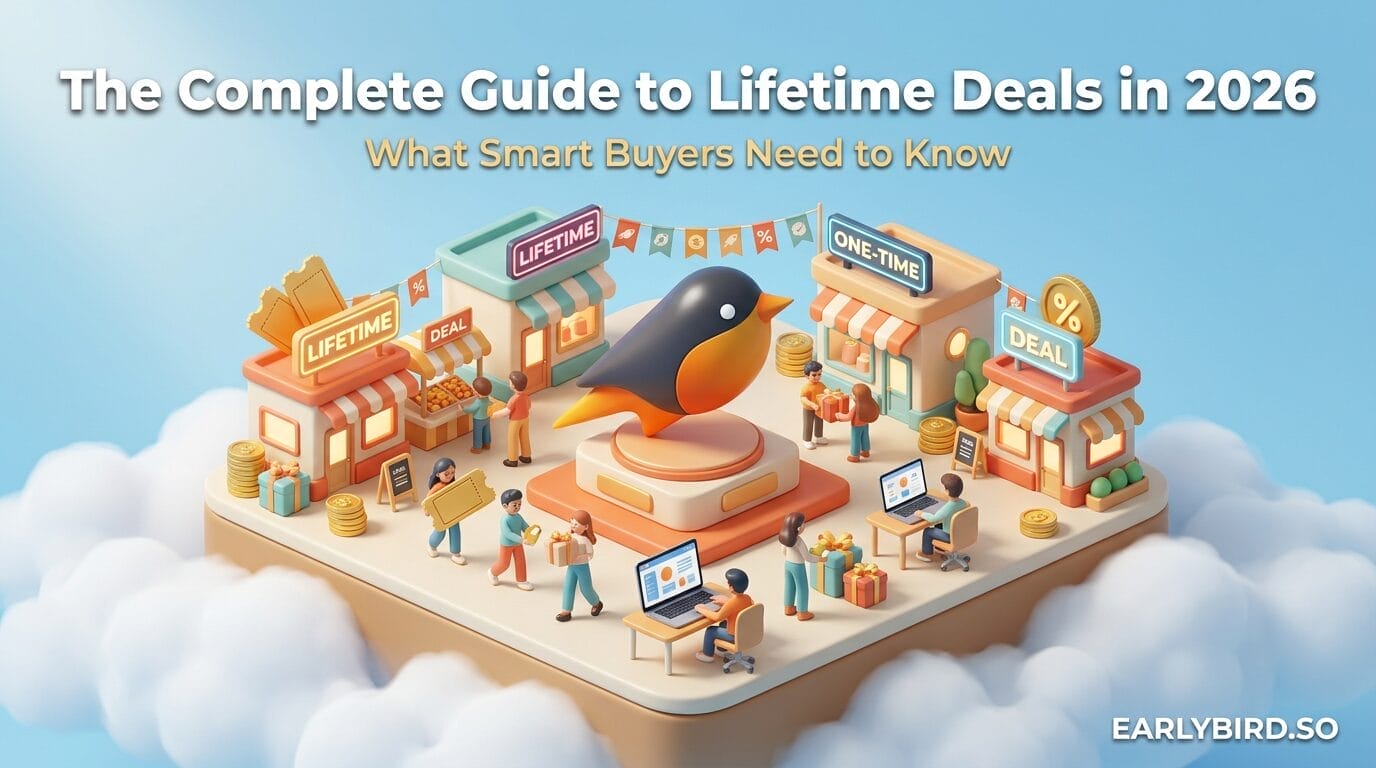
Let’s address the elephant in the room first.
Every year, someone declares lifetime deals dead. “The model doesn’t work.” “Companies can’t sustain it.” “You’re just buying vaporware.”
And every year? They’re proven wrong.
Here we are in 2026, and the lifetime deal market isn’t just alive – it’s exploding. More than 200 active deals are available across major platforms right now, with new launches happening weekly. Understanding why this is happening will help you spot the deals worth buying versus the ones that’ll disappoint you six months in.
Google Ads, Meta Ads, LinkedIn Ads. The holy trinity of customer acquisition just got expensive. Like, “burn through $10K and get 50 trial signups” expensive.
For early-stage SaaS companies, the math has broken down completely. You’re paying $5-15 per click, converting maybe 2-5% to trial signups, then converting 20-30% of those trials to paid customers. That’s $200-500+ per customer acquisition. For a $29/month product, you’re looking at 7-17 months just to break even, assuming zero churn.
Lifetime deals flip this entirely. Zero upfront marketing costs. Immediate cash flow. Real users providing feedback. You build your user base without betting the company on paid ads.
For buyers? Those $29/month subscriptions pile up fast. That’s $348/year per tool, $1,740 over five years. Or pay $89 once and own it. When you’re running a lean business with six or eight SaaS subscriptions, cutting half to lifetime deals saves you thousands annually.
One payment. Lifetime access. No renewal emails. No surprise price increases.
That’s the deal.
A lifetime deal means you pay once and get permanent access to the software. The catch? “Lifetime” refers to the product’s lifespan, not yours.
If the company tanks in year two, your lifetime deal goes with it. This is why due diligence matters more than the discount percentage. A tool that saves you 95% but disappears in six months costs more than a tool that saves you 70% and runs for five years.
Understanding the business model helps you spot good deals from desperate cash grabs.
When a SaaS company offers a lifetime deal, they’re making a calculated trade-off. They exchange long-term recurring revenue for immediate capital, user growth, and market validation. For bootstrapped companies, five years of subscription revenue arriving today means hiring developers, improving the product, and extending runway. That’s not gambling on retention – that’s profit today.
User acquisition without ad spend is massive. Most lifetime deal platforms don’t charge upfront fees – they take commission after sales, usually 30-50%. You’re getting free marketing and distribution. Product validation from real users beats surveys. Lower transaction costs add up – processing one $89 payment costs less than 60 monthly $29 payments over five years.
But every upside has a downside. Support becomes expensive when customers generate no recurring revenue but still need help. Some companies handle this well. Others ghost lifetime customers while prioritizing monthly subscribers. Product development incentives change after the sale. The best companies have healthy mixes of lifetime and monthly customers. The monthly revenue funds ongoing development everyone benefits from.
Company viability is the ultimate risk. If they run out of money, your lifetime access disappears. Look for companies with funding, diverse revenue sources, or clear profitability paths. A company with 1,000 monthly subscribers and 500 lifetime customers is more stable than one with 2,000 lifetime customers and zero recurring revenue.
The market has matured significantly. Discounts typically range from 80-95% off retail pricing. The 60-day money-back guarantee has become standard across reputable platforms. This matters – it signals platforms are vetting products enough to stand behind them for two months.
According to 2025 research, 57% of consumers now actively hunt for deals, up 23% from the previous year. But they’re smarter about it. People are trading down in some categories to splurge on tools they genuinely need. The average B2B software purchase now involves 13 decision-makers. Everyone’s doing more homework.
Nearly 70% of the buyer’s journey happens before anyone talks to sales. The “impulse buy everything at 90% off” era is ending.
The market has diversified beyond one or two dominant players. Each platform has its own approach, and knowing the differences helps you find deals that match your needs.
Earlybird takes a fundamentally different approach than most platforms. Instead of listing every available deal, they curate aggressively. Not every tool makes the cut, even if the founder offers steep discounts. The focus is on product quality, company viability, and genuine value.
This matters because you spend less time researching and more time building. The curation pre-screens for company sustainability and product-market fit. You’re still doing your own due diligence, but you’re starting from a higher baseline.
The trade-off is selection. You’ll find fewer total deals at any given moment, but the deals you find are more likely to be worth your time. For buyers who value their time and want to avoid sorting through mediocre options, this approach makes sense.
AppSumo is the biggest name in the space, and they’ve earned that through sheer volume. You’ll find deals across virtually every category, which is both a strength and a weakness. There are solid products on the platform, but the lighter vetting process means quality varies significantly from deal to deal.
One thing worth considering is sustainability. Because founders typically retain a smaller portion of the revenue, some struggle to maintain and grow their product after the deal ends. That’s contributed to a pattern where a noticeable number of tools launched on AppSumo go quiet or shut down within a year or two. It’s not every deal by any means, but it happens often enough to be worth factoring into your buying decisions.
The review system helps with evaluation, but pay attention to timing. A 4.5-star review from 200 users who bought two days ago tells you less than a 4.0-star review from 2,000 users who’ve had the product for six months.
RocketHub specializes in launching brand new tools, including products they’ve built in-house. That dual role as marketplace and product creator gives them a unique angle in the space, and they’ve carved out a niche around early-stage discovery.
One thing worth being aware of is pricing. Deals on RocketHub sometimes carry higher base prices with smaller percentage discounts, which can mean the final price is higher than what you’d find for similar tools on other platforms. It’s also happened that products which launched on RocketHub later became available elsewhere with different pricing and deal structures. Not a dealbreaker, but it’s always smart to shop around and compare before pulling the trigger on any platform.
SaaSzilla started with promise and looked like it could become a solid player in the lifetime deal space. Unfortunately, the platform has run into serious issues that are hard to overlook.
Multiple founders who launched on SaaSzilla have reported not receiving their payouts. Affiliate partners have experienced the same. On the buyer side, support has been largely unresponsive and refund requests have gone unaddressed. When the experience breaks down for sellers, promoters, and buyers alike, it’s a sign of deeper problems. We’d recommend holding off on the platform until there’s clear evidence things have improved.
Dealify covers significant ground from development tools to creative platforms to business software. The diversity is both good and bad – good because you might find unexpected tools, bad because the breadth makes it harder to develop expertise in any category. Works well as a secondary platform to check.
StackSocial has been around longer than most. They offer both digital and physical products, with daily deals reaching 70% off for courses and 40% off for software. The mix of products means software isn’t their only focus, so pure SaaS selection is smaller than dedicated platforms.
DealFuel specifically targets web developers, designers, and entrepreneurs. Deals skew technical, with emphasis on development tools, design assets, and technical resources. If you’re building digital products, DealFuel is worth monitoring. Tools here often have features that appeal to developers specifically, not just general business users.
Prime Club focuses on launching deals for established products and founders they have relationships with. That relationship-driven approach means you’re more likely to see tools with existing user bases and track records, which is a genuine plus.
Where things get a bit mixed is on the execution side. Some launches have had confusion around deal terms or communication gaps that created unnecessary back-and-forth for buyers. There have also been cases where products like Integrately, BigMaker, and Linktree were associated with Prime Club despite not actually launching on the platform, which can be confusing for the community.
Prime Club also uses urgency-based promotions like countdown timers and limited availability windows. That works well for some buyers who like having a deadline to make decisions. Others prefer more breathing room to evaluate a product properly. Just depends on your shopping style.
Product Canyon targets small and medium-sized businesses specifically. Their curation emphasizes user-friendly tools that don’t require technical expertise. If you need tools that “just work” without a learning curve, Product Canyon is worth checking. Pricing is competitive, and they’ve built a reputation for responsive customer service.
Stop buying based on discount percentages. Start using this framework to separate legitimate deals from disasters waiting to happen.
Before testing the product, research the company. How long have they been in business? Less than six months is higher risk – you’re betting on a startup surviving. Companies with 1-2 years and growing user bases are safer bets.
Do they have funding or revenue beyond lifetime deals? Check their about page, search LinkedIn for founders, look them up on Crunchbase. Companies with angel funding, revenue from monthly subscribers, or previous successful exits are more likely to be around in three years.
What’s their product roadmap? Companies confident in their future plans share them publicly. Companies avoiding that conversation might not have one. Are they active and responsive? Check social media, blogs, and support channels. Ghost towns suggest founders have moved on.
“Lifetime” doesn’t always mean what you think. What specific features are included? Some deals include only current features, with future features reserved for monthly subscribers. Others include everything forever. This matters enormously for long-term value.
What are the usage limits? Users per account, projects, storage, API calls, monthly active users determine whether the deal actually works for your use case. A “lifetime deal” capping you at 1,000 email sends per month isn’t very lifetime if your business needs 5,000 monthly.
Can you stack codes for higher tiers? Many platforms let you buy multiple codes to unlock higher usage limits. If you’re buying a tool you plan to grow with, this flexibility matters. Check before buying whether stacking is allowed and what limits it raises.
Skip the testimonials on the sales page – those are curated. Read every review on the lifetime deal platform. Look for patterns. If ten people mention slow support, that’s not random. If users report features breaking after updates, that’s a warning. If they rave about the founder’s responsiveness, that’s a green flag.
Search Reddit for the product name. People are brutally honest there. Check Twitter for real-time feedback. Join their community if they have one – active communities with engaged founders suggest the company cares.
Set a calendar reminder for day 45 of your purchase. This gives you 15 days of buffer before the refund window closes. Use the product for real work, not just clicking around. Test core features thoroughly. Contact support with a real question – response time predicts long-term satisfaction more than features do.
Everyone shows you this: $29/month equals $1,740 over five years. Lifetime deal $89 one-time. But add these questions: Will you actually still need this tool in five years? Is the company likely to survive? Does the lifetime tier include what you need, or will you need upgrades?
Calculate conservatively. Assume 25-50% of lifetime deals won’t make it five years. Either the company fails, the tool becomes obsolete, or your needs change. That $500 investment realistically becomes $750-1,000 when you account for replacements. You’re still saving thousands compared to subscriptions – just be realistic about it.
Run away fast if you see: brand new product with zero users (you’re a beta tester who paid for it), company selling unlimited lifetime deals with no monthly revenue (the math doesn’t work), key features only available to monthly subscribers (you’re second-class), no product updates in 6+ months (they’ve moved on), overwhelmingly negative recent reviews (trust the pattern), support taking weeks to respond (it’ll get worse), founder making impossible promises (disappointment incoming).
Buy with confidence when you see: healthy mix of lifetime and monthly subscribers (monthly revenue funds development), regular product updates with detailed changelogs (transparency matters), founder actively engaged in community (not outsourced support), support responding within 24-48 hours (systems are in place), growing user base with vocal advocates (real advocacy beats testimonials), clear public product roadmap (they know where they’re going), existing funding or revenue beyond lifetime deals (they have runway).
The 95% discount looks incredible. You’ve always thought this category might be useful someday. You buy it. Six months later, you’ve never logged in.
The real cost isn’t the $89 you spent. It’s the opportunity cost. You could have put that money toward a tool you’d use daily. Ask yourself before every purchase: “Would I pay full price for this right now?” If the answer is no, you don’t need it at any price. The goal isn’t to own lots of tools. The goal is to own the right tools.
You buy a lifetime deal with good intentions. You’ll test it this week. This week becomes next week. Next week becomes next month. Suddenly you’re at day 75 and you never used the product. The refund window closed 15 days ago.
Set a calendar reminder for day 45 immediately after purchase. Not day 60. Day 45. This gives you buffer to actually test before the window closes. Better yet, block an hour within the first week to do actual testing. Treat it like a meeting you can’t skip.
You save $500 on a lifetime deal. The company shuts down in six months. You spent $500 on six months of access. Compare that to paying $99/month – you would have spent $594 for those six months, but you could have cancelled anytime. Instead, you lost everything when the company folded.
Spend 20 minutes researching. Check Crunchbase for funding. Check LinkedIn for team size and recent hires. Check their blog for activity. Check support forums for engagement. If you can’t find evidence they’ll exist in a year, the discount doesn’t matter.
The $49 tier looks tempting. It’s so cheap! You buy it. Week two, you hit the project limit. Or the user limit. Or the storage limit. Now you need the $149 tier. Some platforms let you pay the difference. Others make you buy whole new codes.
Either way, you’re paying more than if you’d bought the right tier initially. Be honest about your actual needs before buying. If you’re planning to grow, don’t buy the tier that barely fits your current size. The middle tier is usually the sweet spot.
Your lifetime deal collection becomes impressive. Thirty tools. Fifty tools. You paid $4,000 total. You “saved” $40,000 compared to subscription pricing. Except you actively use maybe five of those tools. The rest sit there, purchased with good intentions, never integrated.
The goal isn’t to own the most tools. Buy only tools that solve problems you have right now. Not problems you might have someday. If you can’t articulate the specific problem and how this tool solves it, you don’t need the tool.
Not every tool category works well as a lifetime deal. Understanding which are safe bets versus risky gambles helps you allocate your budget wisely.
Email marketing tools consistently work well if you choose established platforms with healthy user bases. Email is a core business function that won’t disappear. The feature set is relatively stable. You’re sending emails today, you’ll be sending emails in five years. The risk comes from buying email tools from brand new companies without users – deliverability requires established sender reputations. Stick to email tools that have been around at least a year with thousands of existing users.
SEO and keyword research tools make excellent lifetime deal candidates. SEO is a long-term game. You’ll need keyword research, rank tracking, and backlink analysis as long as you’re building web presence. Look for SEO tools that focus on specific use cases rather than trying to do everything. An affiliate marketer’s SEO tool. A local business SEO tool. A content publisher’s SEO tool. Specialized tools deliver better value than generic ones.
Design and creative tools work wonderfully as lifetime deals because you’ll need them forever. Creating social media graphics, designing presentations, editing images, building mockups – these are permanent needs. The key is choosing tools with mature feature sets. If a design tool promises revolutionary AI features coming soon, wait until they actually ship. Buy based on what exists today.
Productivity and project management tools make sense for solo operators and small teams. Project management needs don’t radically change. You’re tracking tasks today, you’ll be tracking tasks in five years. However, be cautious with project management tools if you’re rapidly growing. As you scale past 10-15 people, you might need enterprise features that lifetime deals don’t include.
Analytics and tracking tools deliver consistent value. Website analytics, form analytics, heatmapping, and user behavior tracking are ongoing necessities. The data you collect compounds over time, making long-term ownership especially valuable. Choose analytics tools that don’t rely heavily on expensive third-party APIs or data storage – those economics don’t sustain lifetime deals well.
Cutting-edge AI tools represent the highest risk right now. The AI space moves incredibly fast. What’s cutting-edge today is obsolete in six months. Companies have high failure rates as capabilities concentrate in fewer, better-funded platforms. If you’re buying AI tools as lifetime deals, buy for current capability, not future promises. Assume the tool will never improve from its current state.
Social media management tools carry moderate risk. Social platforms change algorithms constantly. APIs get deprecated. Platforms die. A social media tool that works perfectly today might be useless in two years. If you’re buying social media tools, favor ones handling multiple platforms. A tool that only works with Twitter is bigger risk than one handling Twitter, LinkedIn, Facebook, and Instagram.
Highly specialized niche tools might not fit your needs long-term. Your business evolves. Your focus shifts. That incredibly specific tool solving a particular problem today might be irrelevant next year when you pivot. Buy niche tools only when you’re confident the need is permanent.
Tools with heavy ongoing API costs worry me as lifetime deals. Some tools rely on expensive third-party services – OpenAI API calls, data enrichment, address verification, communication APIs. These costs don’t go away after the sale. Companies either cap usage severely for lifetime users or eat the costs and risk going under. If a tool requires expensive API calls for core functionality, subscription pricing makes more sense.
Every tool launching in 2026 includes AI features. Some are genuinely useful. Many are less so. When evaluating AI-powered lifetime deals, ignore the buzzwords. Focus on what the tool actually does. If the AI disappeared tomorrow, would you still find value?
More companies are experimenting with base features available lifetime, premium features available monthly. These hybrid models actually solve real problems – they give companies sustainable recurring revenue while protecting your lifetime investment. Don’t automatically reject them. Evaluate whether the base lifetime tier provides genuine value on its own.
The platforms that survive will be the ones that say no. Quality curation creates a competitive advantage that volume can’t match. When a platform develops a reputation for featuring only legitimate products from viable companies, buyers trust their judgment. Expect more specialized platforms focusing on developer tools, B2B SaaS, or AI-powered products.
Lifetime deal buyers in 2026 are dramatically more sophisticated. This sophistication raises the bar for everyone. Companies can’t succeed with inferior products. Platforms can’t thrive by listing everything. The market is getting better at filtering out bad deals before they reach you.
Start with your current subscriptions. List every monthly SaaS subscription with costs. Honestly assess which you’d consider replacing. Don’t replace tools you love just to save money. Do consider replacing expensive tools with stable lifetime alternatives.
Identify high-ROI replacement opportunities. Replacing a $99/month SEO tool with a $149 lifetime deal breaks even in six weeks. Focus on tools you’re confident you’ll use for at least two years.
Calculate real savings conservatively. Assume 25-50% of lifetime deals won’t make it five years. You’re still saving thousands compared to subscriptions, just be realistic about it.
Build gradually and test thoroughly. Replace one tool at a time. Test it for real work for at least two weeks. Keep at least one month of overlap between buying the new tool and cancelling the old subscription.
The lifetime deal market in 2026 is real, growing, and worth your attention. With 200+ active deals and discounts ranging from 80-95%, the opportunity is significant. But success requires strategy, not impulse buying.
The discount percentage is not the product. Company viability matters more than savings. Testing during refund windows saves you from expensive mistakes. Building gradually beats replacing everything at once.
Buy tools that solve problems you have right now. Test them thoroughly. Research company sustainability. Calculate conservative ROI. The smartest SaaS buyers aren’t avoiding lifetime deals – they’re using them strategically to build sustainable tech stacks without subscription fatigue.
Do your research. Test thoroughly. Buy carefully.
Ready to explore quality lifetime deals? Check out Earlybird’s current deals where every deal is curated for quality, not just discounts.
Want to launch your own lifetime deal? Apply to partner with Earlybird and we’ll help you structure a deal that works long-term.
Join the Bird Gang – Get new deals delivered straight to your inbox. No spam, just carefully selected opportunities worth your attention.