Join the Bird Gang
Get Offers, Discount Coupons Exclusive Deals directly to your Inbox
Get Offers, Discount Coupons Exclusive Deals directly to your Inbox
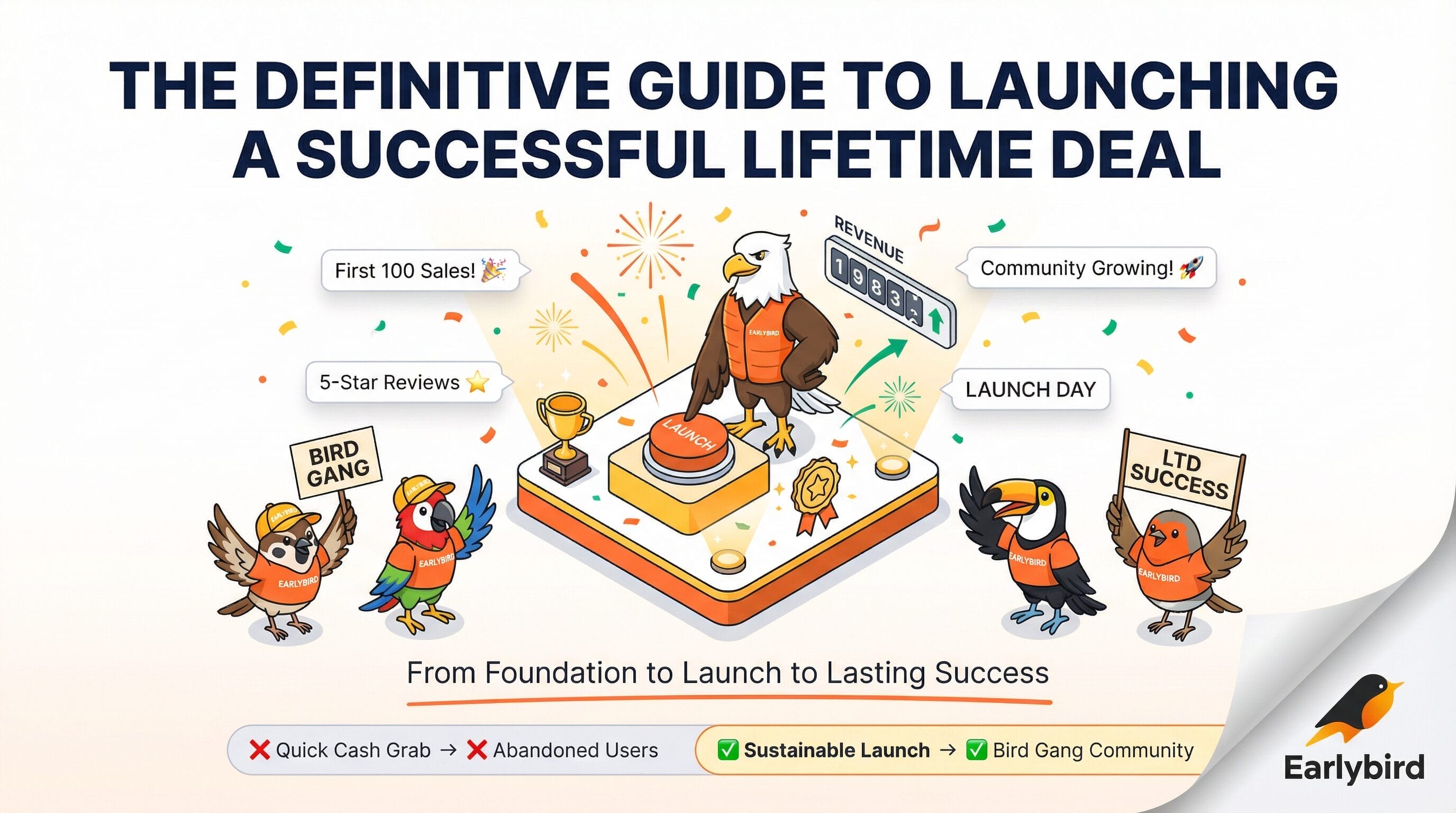
The definitive guide for SaaS founders who want to turn their lifetime deal launch into sustainable growth
After nearly a decade in the lifetime deal space, patterns emerge. You start to recognize which launches will thrive and which will struggle before they even begin. The surprising truth? Product quality alone does not determine success. Timing plays a smaller role than most founders assume. Even pricing, while important, is not the deciding factor.
What separates successful lifetime deal launches from failed ones is whether founders truly understand what they are getting into.
This guide breaks down everything you need to know about launching a lifetime deal in 2026. Whether you are considering your first LTD launch or looking to improve on a previous attempt, this resource covers the strategic foundations, practical considerations, and hard truths that determine outcomes.
Let us address the elephant in the room first. Every year, skeptics declare lifetime deals dead. Every year, they are proven wrong.
The lifetime deal model is not dying. It is evolving. And founders who understand this evolution are achieving remarkable results.
For software buyers, lifetime deals offer something increasingly rare in a subscription dominated world: ownership. Consider what LTD buyers receive:
Financial predictability. One payment eliminates the mental overhead of recurring subscriptions. No surprise price increases. No renewal negotiations. The software becomes an asset rather than an ongoing expense.
Protection against subscription fatigue. The average business now juggles dozens of software subscriptions. Each one represents a recurring decision point, a potential budget line item to cut during tight months. Lifetime access removes the tool from this constant evaluation cycle.
Early adopter advantages. LTD buyers often receive founder tier access, priority feature requests, and grandfathered pricing on future additions. They become part of the product story rather than anonymous subscribers.
For SaaS founders, lifetime deals create opportunities that subscription models cannot match:
Immediate capital injection. A well executed LTD launch can generate months or even years of runway in a concentrated period. This capital arrives without dilution, debt, or strings attached.
Rapid user base development. Building momentum in SaaS typically requires sustained effort over extended periods. Lifetime deals compress this timeline dramatically, delivering hundreds or thousands of active users in weeks.
Authentic feedback from invested users. Free trial users churn. Freemium users often stay passive. But customers who have paid for lifetime access are invested in your success. They report bugs, suggest features, and provide the kind of honest feedback that shapes product direction.
Marketing amplification. Lifetime deal communities are active and vocal. A successful launch generates reviews, testimonials, social proof, and word of mouth momentum that extends far beyond the initial promotion period.
The model works. The question is whether you can execute it correctly.
More lifetime deal launches fail due to poor unit economics than any other single factor. This failure typically follows a predictable pattern.
A founder decides on pricing based on what sounds attractive to buyers. Forty nine dollars for lifetime access seems compelling. Ninety nine dollars for a pro tier feels premium but accessible. These numbers often come from intuition, competitor research, or simple guesswork.
The launch succeeds by surface metrics. Hundreds of sales come through. Revenue hits five figures. The founder celebrates.
Then reality sets in.
Hosting costs climb as users actually use the product. Support tickets accumulate faster than anticipated. Those AI features that seemed like brilliant differentiators are consuming API credits at alarming rates. The unlimited storage promise becomes a financial black hole.
We have witnessed founders generate thirty thousand dollars in a week and still find themselves underwater three months later because they never calculated their true costs.
Before you set a single price point, you need to understand exactly what each user costs you. Not an estimate. Not a rough guess. The actual, documented number.
Infrastructure costs per user. Calculate your hosting, database, CDN, and storage costs. Determine how these scale as users increase. Many cloud services have pricing tiers that create unexpected jumps at certain usage levels.
Third party service costs. If your product integrates AI capabilities, payment processing, email sending, SMS messaging, or other external services, map out exactly what each user interaction costs. AI API calls can be particularly deceptive because costs vary dramatically based on usage patterns.
Support costs per user. Review your support ticket data. How many tickets does the average user generate? How long does resolution take? Assign a realistic hourly cost to support time and multiply accordingly.
Development and maintenance allocation. Your product requires ongoing work. Bug fixes, security patches, dependency updates, and feature development all require resources. Determine a reasonable per user allocation for these ongoing costs.
Buffer for the unexpected. Cloud service prices change. Third party APIs get deprecated. Usage patterns shift as your product evolves. Build a meaningful buffer into your calculations.
Once you have this number, compare it against your intended pricing. A lifetime deal price needs to cover multiple years of these costs while still contributing to sustainable growth. If the mathematics do not work, adjust your pricing or reconsidered whether an LTD is right for your current stage.
Here is the most difficult advice to accept: your product probably is not ready for a lifetime deal.
This is not a criticism. It is a reality check that could save you months of pain.
Lifetime deal customers have fundamentally different expectations than beta users. They are not signing up to help you build something. They are paying because they believe in what you have already built.
This distinction creates critical misalignment when products launch too early:
Support burden multiplication. Beta level bugs that a handful of patient early adopters might tolerate become overwhelming when multiplied across hundreds of paying customers. Each bug report requires acknowledgment, investigation, and resolution. Your development roadmap gets hijacked by firefighting.
Review damage. Lifetime deal communities share experiences actively. Negative reviews spread quickly and persistently. A product that launches with significant issues will accumulate negative sentiment that haunts future marketing efforts.
Refund cascade. Unhappy customers request refunds. High refund rates damage your relationship with deal platforms and create administrative overhead that compounds other problems.
Founder burnout. Nothing drains enthusiasm faster than spending months apologizing for issues and promising fixes that keep getting pushed back. The capital injection that was supposed to fund growth instead funds damage control.
Your product is ready for a lifetime deal when it can honestly answer yes to these questions:
Core functionality stability. Can users complete the primary workflow your product promises without encountering blocking bugs? This means real testing with real users, not your own internal team clicking through familiar paths.
Performance under load. Have you tested how your infrastructure handles concurrent users? What happens when a hundred people try to do the same thing simultaneously? Lifetime deal launches can generate usage spikes that expose scaling issues.
Documentation and onboarding. Can a new user understand your product without personal assistance? During a launch, you cannot hand hold every customer through setup. Self service resources need to actually work.
Support infrastructure. Do you have systems to handle elevated support volume? This includes ticket management, knowledge base content, and clear processes for escalation.
Roadmap confidence. Are you committed to continuing development on this product for years? Lifetime customers expect ongoing improvement. They will notice if development slows or stops.
If you cannot confidently answer yes to each of these questions, consider whether launching now is truly in your best interest. A delayed launch with a polished product almost always outperforms a rushed launch with an unfinished one.
The word lifetime appears in marketing copy for all sorts of products. For software, it carries weight that founders sometimes underestimate.
When someone purchases lifetime access to your software, they reasonably expect that access to continue for years. Perhaps a decade. Perhaps longer. This is not about legal technicalities or terms of service fine print. It is about trust.
Before launching a lifetime deal, founders need to honestly assess their commitment:
Business sustainability. Can you realistically maintain this product five years from now? What about ten? If your honest assessment is uncertain, that uncertainty deserves careful consideration.
Cost trajectory. Your hosting costs today are based on current infrastructure and user counts. What happens if costs double? What if critical third party services raise prices or shut down? Do you have contingency plans?
Personal commitment. Startups require sustained effort. The initial excitement of a launch fades. The day to day work of supporting customers and improving the product continues indefinitely. Are you prepared for that ongoing commitment?
Exit planning. If you eventually sell or transition away from this product, what happens to lifetime customers? Responsible founders think through these scenarios before they become urgent.
When founders treat lifetime deals as quick cash grabs, the entire ecosystem suffers. Buyers become skeptical. Platforms increase vetting requirements. The reduced trust makes life harder for founders who genuinely intend to honor their commitments.
Building a sustainable software business requires thinking beyond the immediate transaction. The founders who succeed with lifetime deals are the ones who view each sale as the beginning of a relationship, not the completion of a transaction.
Pricing lifetime deals requires balancing multiple competing priorities. You need prices attractive enough to drive sales while sustainable enough to support long term delivery. You want to create urgency without resorting to manipulative tactics that erode trust.
Most successful lifetime deals use tiered pricing that serves different customer segments:
Entry tier. This lowest priced option serves individual users with basic needs. It typically includes core functionality with some limitations on usage volume or advanced features. The goal is accessibility combined with clear value.
Professional tier. The middle tier targets power users and small teams. It expands on the entry tier with higher limits, additional features, and often some team functionality. This tier usually generates the highest volume of sales.
Business tier. The highest tier serves larger teams or users with demanding requirements. It includes maximum limits, all features, priority support, and often custom implementation assistance. Volume is lower, but per sale value is highest.
For each tier, work through this calculation:
The resulting number might be higher than your initial instinct. That is often correct. Sustainable pricing serves customers better than attractive pricing that leads to an unsustainable business.
Creating urgency drives action, but manufactured urgency erodes trust. Effective approaches include:
Genuine scarcity. If you are only offering a limited number of lifetime deals to protect your economics, state that honestly. Real limitations create real urgency.
Time bounded availability. Lifetime deal windows with clear start and end dates provide natural urgency without requiring artificial tactics.
Early bird incentives. Rewarding fast action with meaningful bonuses respects both early buyers and those who need more consideration time.
What to avoid: fake countdown timers that reset, manufactured stock limitations, or pressure tactics that create regret rather than satisfaction.
Successful lifetime deal launches require extensive preparation. Use this comprehensive checklist to ensure readiness:
After years of observing launches across numerous platforms, clear patterns emerge among founders who achieve lasting success:
Successful founders know their numbers cold. They can explain their cost structure in detail. They have modeled scenarios for different user volumes and usage patterns. When challenges arise, they have financial context for decision making.
This knowledge shows up in pricing decisions that balance attraction with sustainability. It shows up in feature decisions that consider long term cost implications. It shows up in confidence during negotiations and customer conversations.
The launches that succeed feature products that work reliably. Not perfectly. Not with every imaginable feature. But consistently and dependably for their core use case.
These products have been tested by real users over meaningful time periods. The obvious bugs have been found and fixed. The common use cases have been optimized. The product does what it promises.
Successful founders price based on sustainability, not aspiration. They would rather sell fewer deals at sustainable prices than sell many deals at prices that create future problems.
This discipline is difficult. Lower prices feel more likely to succeed. But experienced founders recognize that short term sales volume matters less than long term viability.
The founders who succeed do not view their lifetime deal as a one time event. They continue shipping improvements. They remain responsive to customer needs. They build on the initial launch rather than cashing out and moving on.
This commitment shows up in their communication style. They talk about long term plans, not just immediate features. They express genuine interest in customer success, not just customer acquisition.
The launch represents a beginning, not an ending. How you handle the post launch period determines whether your lifetime deal generates lasting value.
Support response excellence. The first impression for many customers comes through support interactions. Prioritize response time and resolution quality during the high volume post launch period.
Proactive communication. Share updates on bug fixes, upcoming features, and product improvements. Customers appreciate transparency about roadmap and progress.
Feedback collection and response. Lifetime deal customers provide valuable input. Collect feedback systematically and demonstrate that you act on it.
Feature development. Continue improving your product. Lifetime customers notice when development continues actively. They also notice when it slows or stops.
Community cultivation. Create spaces for customers to connect with each other and with your team. Active communities generate organic marketing and reduce support burden through peer assistance.
Upgrade opportunities. As your product evolves, create reasonable paths for lifetime customers to expand their access. New products, add ons, and service offerings provide mutual benefit without undermining original commitments.
Lifetime deals are not dying. Lazy lifetime deals are.
The founders who win in 2026 and beyond are the ones who respect what this model represents. They respect the buyers who trust them with their money. They respect the platforms that connect them with audiences. They respect the broader ecosystem that makes lifetime deals possible.
This respect manifests in thorough preparation. It shows up in sustainable pricing. It appears in ongoing commitment to product improvement and customer success.
The opportunity remains significant. Software buyers increasingly seek alternatives to endless subscriptions. Founders who can deliver genuine lifetime value will find eager audiences and sustainable businesses.
The question is whether you are prepared to do it right.
Earlybird works with SaaS founders who are serious about building sustainable products and honoring their commitments to customers. Our curation process ensures that every deal we feature meets the standards that the Bird Gang community expects.
If your product is ready and you are committed to the long term success of your customers, we want to hear from you.
Apply to launch with Earlybird
We review every application carefully and provide honest feedback on readiness and positioning. Whether you launch with us or continue preparing, you will gain valuable perspective on your lifetime deal strategy.
Join the founders who are building lasting relationships with customers through thoughtful, sustainable lifetime deals.